Where Did the Day Go? The Hidden Overhead Eating Your Engineers Alive
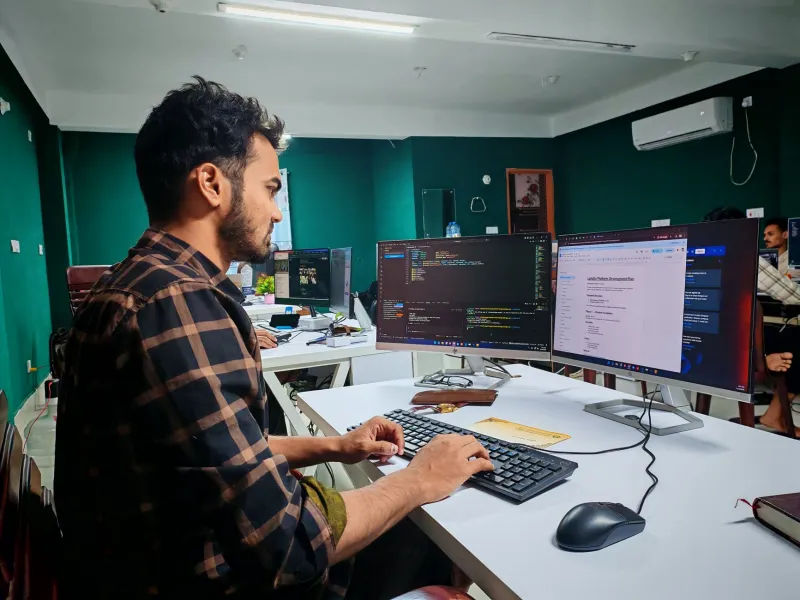
Ask any senior engineer what their day actually looks like, and you'll hear a version of the same story. They sat down at 9am with every intention of finishing that feature branch. By 2pm, they'd been in three meetings, answered forty-seven Slack messages, reviewed a PR, filled out a ticket, and explained the same architectural decision twice to two different people. They wrote maybe ninety minutes of actual code.
That's not a personal productivity problem. That's a systemic one.
Research from various engineering productivity studies consistently points to the same uncomfortable number: developers in mid-to-large organizations spend somewhere between 30 and 45 percent of their working hours on tasks that have nothing to do with writing, reviewing, or improving code. For your best engineers—the ones everyone wants a piece of—that number skews even higher.
This is the invisible tax. It doesn't show up on a sprint board. It doesn't get flagged in your retrospective. But it's compounding every single week.
What Actually Counts as Engineering Time
Before you can fix the problem, you have to be honest about what you're measuring. Most teams conflate being busy with being productive, and those are not the same thing.
Genuine engineering time includes writing code, debugging, architectural thinking, meaningful code review, and the kind of deep problem-solving that requires sustained concentration—what researchers call a flow state. Getting into flow typically takes 15 to 25 minutes of uninterrupted focus. Breaking it takes about two seconds. A single Slack notification can cost you 20 minutes of recovered concentration, even if you don't respond.
Everything else—standups, planning sessions, one-on-ones, Jira updates, Confluence docs, Slack threads, cross-team syncs, ad hoc questions from product managers—lives in a different category. Some of it is genuinely necessary. A lot of it isn't. The problem is most teams have never actually separated the two.
Run the Numbers on Your Own Team
Here's a simple exercise worth doing with your team before your next planning cycle. Ask engineers to track their time for one week across three buckets: deep work (flow-state coding and design), shallow work (low-cognitive tasks like updating tickets or async comms), and meetings/synchronous interruptions.
Don't guess. Actually track it. Tools like Clockwise, Reclaim.ai, or even a basic time-blocking journal work fine. What most teams find when they do this is genuinely alarming. Engineers who believed they were coding six hours a day discover they're closer to three. The gap gets swallowed by things nobody explicitly scheduled and nobody explicitly owns.
Once you have that data, you have leverage. It's a lot easier to make the case for structural changes when you can show a VP of Engineering that their team's highest-paid talent is spending Tuesday afternoons in a recurring sync that produces no decisions.
The Meeting Problem (It's Worse Than You Think)
Meetings are the most visible offender, but they're also the most culturally entrenched. In a lot of American tech companies, meeting density has become a proxy for collaboration and alignment. If you're in meetings, you're engaged. If your calendar is packed, you're important.
This is backwards.
The most destructive meeting pattern isn't the two-hour all-hands—it's the thirty-minute recurring sync that exists because it was useful once, eight months ago, and nobody has gotten around to canceling it. These meetings don't just cost thirty minutes. They fragment the schedule around them, making it nearly impossible to build the contiguous blocks of time that deep work requires.
A few interventions that actually work: audit every recurring meeting quarterly and kill the ones that can't justify themselves. Implement meeting-free mornings or full no-meeting Wednesdays—companies like Asana and Shopify have done versions of this at scale. Default to async for anything that doesn't genuinely require real-time discussion. A Loom video or a well-written Slack message handles more than most teams admit.
Taming the Slack Hydra
Slack is where good intentions go to die. The platform was sold as an email killer. What it became, for most engineering teams, is a faster, more anxious version of email that also interrupts you in real time.
The fix isn't abandoning it—it's establishing explicit norms around response expectations. Engineers shouldn't feel obligated to monitor Slack continuously during deep work blocks. A response window of two to four hours for non-urgent messages is entirely reasonable and should be stated explicitly in your team's working agreement.
Status indicators help, but only if the culture backs them up. If an engineer sets themselves to Do Not Disturb and still gets @mentioned three times, the tool isn't the problem—the culture is.
Consider tiering your communication channels by urgency. True emergencies (production is down, a deploy is broken) get a different channel with a different norm than general questions or async updates. When everything feels urgent, nothing actually is, and engineers pay the price.
Administrative Overhead Nobody Talks About
Ticketing systems, documentation requirements, and process compliance are the quieter offenders. Every JIRA ticket that needs three fields filled out before an engineer can mark it done, every PR template that requires five checkboxes, every sprint ceremony that exists because the process says so—these aren't free.
Individually, they're minor. Collectively, they add up to hours per week of low-value cognitive overhead that engineers resent and managers don't see.
The audit question here is simple: for every process or artifact your team produces, ask who uses it and what decision it informs. If the answer is unclear, you've found overhead that's ripe for elimination or simplification.
Building Back the Space to Actually Build
Reclaiming engineering time isn't about demanding more hours from your team. It's about protecting the hours they already have.
Start with time-blocking at the team level, not just the individual level. Coordinate deep work windows so that the engineers who need to collaborate aren't scheduling focus time at odds with each other. Treat those windows like production systems—interrupting them should require a real justification.
Make the invisible visible. Put engineering time metrics on the same dashboard as velocity and deployment frequency. When leaders can see that the team averaged 2.8 hours of deep work per day last sprint, it becomes a conversation instead of a complaint.
And give your engineers explicit permission to protect their time. A lot of this overhead persists because nobody has ever told a developer that it's okay to decline a meeting, close Slack for two hours, or push back on a process that wastes their day. Culture change starts with that permission being stated clearly and backed up consistently.
Your engineers aren't slow. They're just being taxed at a rate nobody ever approved.
Fix the tax.